Tuesday, 25 September 2018

Skiing sexism

Image result for toyota skiing sexism

https://www.stylist.co.uk/life/ridiculously-sexist-mosgyny-anti-feminist-adverts-posters-billboards-present-modern-day/69598


n 2016, Toyota decided to advertise their new car on the slopes at Australia’s Thredbo Resort.
Promoting the Kluger as a “great place to raise a snow-loving family”, the banner went on to match the three types of ski runs with different family members.
For those unfamiliar with the terminology, a green run is often reserved for a beginner, a blue run indicates it would be appropriate for a moderately skilled skier, and black diamond runs are reserved for seriously confident skiers – aka the experts.
Guess which one ‘mum’ was given?
The ad was dubbed “lazy”, “dumb”, and “downright stupid” – all of which are pretty fair summations, in our opinion.
And Toyota clearly agreed with critics, promptly removing the banner and releasing an official statement of regret.
“We simply wanted to highlight that Thredbo, much like the Kluger [car], has something for everyone,” a spokeswoman said.
“We have printed the new marketing material and expect that they will be displayed at Thredbo within the next two weeks subject to weather conditions.”

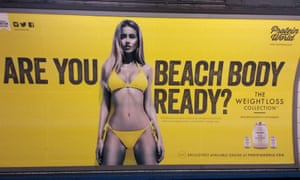
are you beach body ready?

Ad banned in UK gets more light-hearted response in New York’s Time Square and on Instagram. ‘My body is always beach ready. All I need is a swimsuit’

https://www.theguardian.com/us-news/2015/jun/27/beach-body-ready-america-weight-loss-ad-instagram

A Protein World advert displayed in an underground station in London makes New York splash in Times Square.

Do you know how to swim? Yes? OK. Do you need sunscreen for your skin tone? Yes? No? OK. How about a bathing suit? Do you have one of those? OK. Prefer to go naked/keep your shorts on? That’s fine too.
I now declare your body ready for the beach. You are beach body ready. Off you go, have fun. And that is where this article should end.
Instead, it is just about to start. Because the same advertisement that was banned in the UK over body confidence and health concerns at the end of April has now been in the US for almost a month – with little controversy.
The ad features a black and white, svelte-yet-curvy, fair-haired and fair-skinned woman in a bright yellow bikini. Her hair is long and lush, her lips full, and her waist is tiny. Next to her is the simple question: Are you beach body ready?
The question is almost immediately followed by the introduction of “the weight loss collection”. As if to suggest you probably are not beach body ready, and that clearly the step to remedy that involves losing weight.
After sitting in a subway surrounded by the body-shaming-for-profit ads one too many times, and walking by a gigantic, skyscraper-sized version of the ad on 42nd Street, next to Times Square – and staring up in shock – I decided to investigate.
Armed with accessories my body loves to take to the beach (a snorkel, a beach ball, goggles) – accessories that indeed give my body a great sense of beach-readiness – I headed to the foot of the gargantuan Times Square ad on Friday morning. I asked passers by what they thought. Perhaps, after all, I was the only New Yorker worried about my perfect 13-year-old cousin becoming a woman in this kind of world.

‘This ad makes me feel less beach-body ready’

Sherrie Griffith, an 18-year-old New Yorker who is getting ready to attend college (not the beach) in the fall, looked up at the massive neon yellow image featuring the white Barbie-meet-Iggy-Azalea-lookalike figure – henceforth “Godzilla-Barbie” – and took a minute to think.
“I know we both have different shapes. I have more of a gut than her,” she said grabbing her midriff.
“This ad makes me feel less beach body ready because we are in a different position. She’s that,” Griffith said pointing upwards. “I am that,” she said, pointing at herself.
Griffith said she was not sure whether she was beach body ready. She initially confided she wasn’t, and then settled on unsure. (Griffith is beautiful, and I told her so.)

protein world


https://www.buzzfeed.com/rossalynwarren/women-are-improving-this-beach-body-advert-with-their-own-bo?utm_term=.biXngWgNY

 A spokesperson for Transport for London confirmed to BuzzFeed UK News that the adverts are being removed from the underground. They said the posters were at the "end of their advertising cycle" and that although they had seen press about the ads, they were unable to confirm whether official complaints had been been made. 
TfL provided an official statement: “This advertisement will begin to be removed from our network as scheduled from tomorrow. We have received one complaint about it and we will be guided by The Committee of Advertising Practice (CAP) and Advertising Standards Authority (ASA) if a similar advert were to be submitted again. We have zero tolerance towards graffiti on the network and take action to prevent it and remove it.”
* BuzzFeed News also contacted the advertising partner for TfL, Exterion Media Metro Services. An Exterion Media spokesperson said:
"London Underground advertising campaigns typically run for a two-week period. This advertisement was booked as part of a three-week cycle from 13 April to 3 May. This was a unique cycle and part of an industry-wide consensus to realign booking periods with the calendar year. The next posting cycle is Monday 4 May and subject to access, all advertisements will be removed therefore by Friday 8 May."
* The Advertising Standards Authority is launching launch an investigation into the advert campaign after it received 270 complaints, mostly arguing the advert is irresponsible and promotes an "unhealthy" body image.
"I am extremely pleased to hear that TFL will be removing Protein World's ad and although the reason has not been confirmed, I am sure that the public response of over 50, 000 signatures and protests has influenced this decision, and I am proud to have been a part of that. "
Juliette Burton, an actor and comedian, told BuzzFeed News that she tweeted the company because as a teenager she had struggled with anorexia, bulimia, being overweight, and compulsive overeating. She was also diagnosed with depression, anxiety, and bipolar disorder.
"I now campaign and perform comedy to break down stigma and encourage body confidence," she said. When the company sent her the above tweet, Burton said: "Using a winky face doesn't make up for psychological abuse of ads like this."

Sexism, stereotyping and missed opportunities in women's sport

https://www.campaignlive.co.uk/article/sexism-stereotyping-missed-opportunities-womens-sport/1405833
When the Chicago Tribune tweeted "Wife of a Bears’ lineman wins a bronze medal today in Rio Olympics", you might have assumed that media coverage of the Olympics had hit "peak sexism". Yet as the US women’s gymnastics team blew the competition away in their qualifying round, a commentator on NBC opined that the athletes looked like they "might as well be standing in front of the middle of a mall". The ensuing backlash across social media channels highlighted the growing disconnect between consumers’ view of female athletes and the perceived stereotyping by traditional media channels and brands. 
Lisa Parfitt, managing director of sports marketing agency Synergy, believes that mainstream media needs to catch up with consumers because the young generation coming to the fore simply will not accept behaviour that reinforces inequality or discrimination. "Women are athletes in their own right and the media would do well to think about tackling the conscious and unconscious bias that exists. But the debate in itself is progress; without increased profile and coverage, we wouldn’t be having this discussion," she explains.
However, the pace of progress – particularly in terms of the "investment gap" between men’s and women’s sport – is frustratingly slow for industry leaders. Women’s sport accounts for just 5.4% of the value of all sponsorship deals, and a movement towards equal pay and equal prize money remains far from complete. Nicola Miller, director of campaigns and engagement at charity Women in Sport, says there is a latent level of sexism in sport that hasn’t gone away yet. "The Olympics has put the issue under the microscope. From a public perspective, there is more interest in women’s sport but media coverage and sponsorship spend haven’t improved," she says.
According to Miller, while there was a great expectation that London 2012 would provide a tipping point – both in terms of the media coverage and sponsorship of women’s sport – the raised expectations haven’t yet translated into investment. "Consumer attitudes have shifted and brands are starting to catch up but, while the BBC and Sky Sports are making huge inroads into the coverage of women’s sport, we aren’t seeing that shift," she adds.
This year, an all-time high of 45% of Olympic athletes are women and, as the social media-driven #AskHerMore campaign to challenge sexism in the media continues to gain momentum, industry experts believe the expectation for progress will soon be matched by tangible increases in both marketing spend and media coverage. 
Sally Hancock, managing partner of sports sponsorship consultancy Y Sport, says that the industry has seen a greater recognition among media owners of the importance of women’s sport, driven by cash from brands including Newton Investment Management and SSE, which invested in the Women’s Boat Race and women’s football respectively. "The opportunity for brands to be a maverick and drive change is there, but rights holders need to stop looking at women’s sport as a poor relation," she explains.

UFIT

Image result for ufit sexism

https://www.express.co.uk/life-style/life/719160/ufit-fitness-gym-advert-woman-thong-slammed-sexist-obscene

UFit Fitness, based in Cardiff, placed the ad on billboards around the city.
The advert featured a woman in a black thong with the caption: “There’s better things to be stuck behind than the car in front.”
The gym obviously felt the advert was tongue in cheek - however those who spotted the billboard around the city did not agree.
Many took to Twitter to express their outrage over the promotional poster.
Alice Gray, a science blogger, picked up on it first and said it was a prime example of “sexist advertising”.
Others have gone on to follow her example and have tweeted complaints about the gym’s ad.
One said it “encourages men to sexually objectify” women.
Others have said they will be cancelling their membership with UFit Fitness after seeing the billboards.
Caitlin Roper, from women’s rights group Collective Shout, said the advert objectifies women.
Speaking to The Huffington Post, she said: “Companies like UFit Fitness that sexually objectify women to flog products tend to think they are being subversive, edgy, clever.
“The opposite is true - it’s sexist, lazy and completely lacking in any creativity or original thought.
“This kind of advertising is openly hostile to women, likely alienating half of their potential market.
“How is this good for business? Does this gym have so little to offer prospective clients that it’s best marketing strategy is ‘look, women’s backsides’?”
Caitlin also said the campaign image “encourages male gym-goes to sexually objectify female patrons”.
She continued: ““Is this consistent with UFit Fitness’ stance on sexual harassment? Is this kind of behavior tolerated or condoned in the gym? Are female staff members at risk of abusive treatment?
“Women using gyms do so for their own purposes - they do not exist for the enjoyment of men.
“It’s 2016, we shouldn’t have to keep having these same conversations defending women’s humanity.”

Sexism in sport - tennis articles

Sexism

prejudice, stereotyping, or discrimination, typically against women, on the basis of sex.
"sexism in language is an offensive reminder of the way the culture sees women"